 Trusted Since 2001





Mortise cylinder vs rim cylinder is one of those distinctions that looks obvious once you are holding both parts and is almost impossible to resolve from a photograph on a phone. This guide covers how each one mounts, the measuring convention that causes most wrong orders, why the cam matters more than the length, and the short list of checks that stops a cylinder going back in the box.
Quick Summary
A mortise cylinder has a threaded brass body that screws into the lock and drives the lock with a rotating cam on the back. A rim cylinder has a flat back with a long flat tailpiece and mounts with two screws from the inside face of the door. The lock body decides which one you need, not the door and not the key.
Key points
- Start at the lock, not the cylinder. Mortise lock bodies take mortise cylinders. Rim exit devices take rim cylinders.
- The cam is the variable that fails you. A wrong cam threads in perfectly and still will not operate the lock.
- Nominal length is a designation, not a caliper reading. Manufacturers do not all measure from the same datum.
- Jumbo and standard are different diameters. That is why a cylinder sometimes will not start on the thread at all.
- Rim tailpieces get cut to length in the field. Longer is not safer, and excess can bind the lock.
- Collars make up the difference when the cylinder would otherwise sit proud of the trim.
| Feature | Mortise cylinder | Rim cylinder |
|---|---|---|
| Body | Threaded brass, screws into the lock | Smooth, flat back, no thread |
| How it is retained | Set screw in the lock edge, seating in a groove | Two long screws through a back plate from the inside |
| What drives the lock | A cam that rotates | A flat tailpiece that rotates |
| Typical home | Mortise lock bodies, storefront deadlocks, exit device trim | Rim exit devices, rim deadlocks, night latch trim |
| Length comes in | Graduated sizes, commonly 1 inch to 1-1/4 inch | One body size, with the tailpiece cut to suit |
| Field adjustment | Collars and spacer rings | Cut the tailpiece, and shorten the mounting screws |
| Interchangeable core available | Yes | Yes |
In This Guide
- What is the difference between a mortise cylinder and a rim cylinder?
- How do you tell which one you are holding?
- Which lock takes which cylinder?
- Where do you measure a mortise cylinder from?
- What are collars and spacer rings for?
- What is a cam, and why will the wrong one stop the lock working?
- How long should a rim cylinder tailpiece be?
- What are SFIC, FSIC and KIK cylinders?
- What goes wrong when people order cylinders?
- About the author
What Is the Difference Between a Mortise Cylinder and a Rim Cylinder?
The difference is how the cylinder attaches and how it transmits motion into the lock. Everything else follows from those two things.
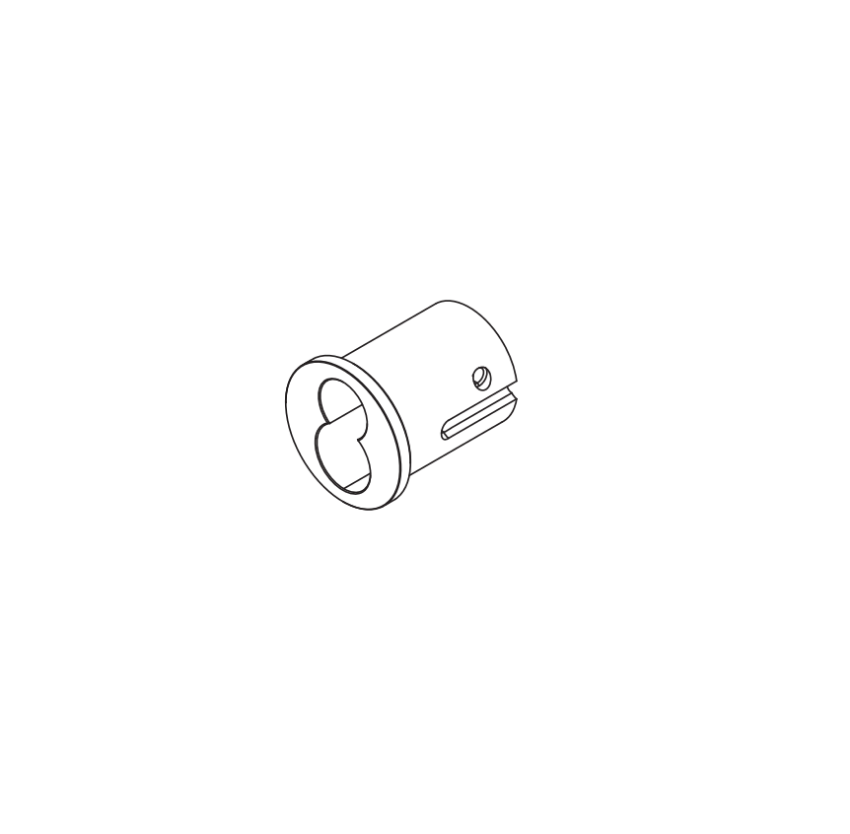
A mortise cylinder threads into a tapped hole in the lock or the door. A set screw in the edge of the lock drops into a groove machined around the cylinder body and holds it from backing out. Because that groove has to line up with the screw, the cylinder has to finish at the correct rotational position, which the trade calls clocking it.
A rim cylinder does not thread into anything. It sits against the outside face of the door, and two long screws pass through the door into the back of the cylinder, usually through a mounting plate on the inside. A flat tailpiece projects back through the door and engages the device.
Both types share the same body diameter in commercial sizes, which is why they look so similar in a parts drawer and so different the moment you turn them over.
How Do You Tell Which One You Are Holding?
Look at the back, not the face. The face of the two is nearly identical.
- Is there a thread on the body? Thread means mortise. A smooth body means rim.
- What sticks out of the back? A cam is a flat plate that rotates around the cylinder axis. A tailpiece is a long flat bar that projects straight back, a bit like a screwdriver blade.
- Is there a groove around the body? Mortise cylinders carry a groove for the set screw. Rim cylinders do not.
- Are there two screw holes in the back? That is a rim cylinder, and those screws come from the inside of the door.
The quickest field shorthand is motion. A mortise cam rotates and catches a plate that pulls back into the lock body. A rim tailpiece rotates and drives the device directly.
Which Lock Takes Which Cylinder?
Work from the device on the door. This is the step that prevents most wrong orders, because people tend to start from the cylinder they removed rather than from what it was fitted to.
| What is on the door | Cylinder type | Watch out for |
|---|---|---|
| Mortise lock body | Mortise | Cam must match the lock maker and often the function |
| Storefront deadlock in an aluminum stile | Mortise | Narrow stile usually means a shorter cylinder and a specific cam |
| Rim exit device | Rim | Tailpiece length and orientation both matter |
| Exit device night latch trim | Rim type tailpiece | Some trim is rated for rim devices only |
| Rim deadlock or jimmy proof lock | Rim | Tailpiece engagement can be shorter than you expect |
| Mortise exit device | Mortise | Mortise devices usually need the mortise specific trim part number |
| Cylindrical lockset | Neither | Takes a key in knob or key in lever cylinder, a different format |
| Deadbolt | Depends on the deadbolt | Commercial deadbolts vary. Check the existing part before ordering |
If the device is a rim exit device, our guide to rim exit devices covers the trim functions that decide whether you need a cylinder at all. For mortise bodies, Schlage L series mortise lock component guide walks through the component categories.
Where Do You Measure a Mortise Cylinder From?
This is the question that generates the most returns, and the honest answer is uncomfortable: the convention is not uniform across manufacturers.
Published guidance variously describes measuring from the underside of the cylinder head to the back of the cylinder including the cam, from the front of the face to the back of the brass body excluding the tailpiece, and from under the head to the outside of the cam. These are not all the same datum, and they do not all give the same number on the same part.
On top of that, at least one major manufacturer states the brass body length only while others include the cam. The practical consequence is that a cylinder sold as a given nominal size may not measure that figure with calipers.
The rule that actually works. Treat the catalogue size as a designation, not a measurement. When you are matching an existing cylinder, measure the old one and order the same nominal size from the same manufacturer family. When you are crossing brands, check that maker's own stated convention before you convert a number.
What Are the Standard Mortise Cylinder Lengths?
Commercial stock sizes cluster tightly. The three you will meet most often are 1 inch, 1-1/8 inch and 1-1/4 inch, and 1-1/8 inch is the general purpose default on a standard door.
| Nominal length | Typical application |
|---|---|
| 3/4 inch | Stocked by some makers for shallow applications |
| 15/16 inch | Appears on some brands and as a calculated requirement on thin trim |
| 1 inch | Common on narrow stile aluminum storefront |
| 1-1/8 inch | The general purpose size on storefront and exit devices |
| 1-1/4 inch | Mortise lock cases and thicker doors. Less common on storefront than people assume |
| Longer than 1-1/4 inch | Specific housings and interchangeable core bodies. Rarely a stock item |
What If You Do Not Have the Old Cylinder?
Without the original part you are working backwards from the opening. The inputs are the door thickness, how far the trim or escutcheon stands off the door face, and how thick the collars are on each side. One approach used in the trade adds the collar thicknesses to the door thickness, subtracts the trim standoff, and halves the result to get a per side length.
Treat that as a starting point rather than a published standard, because it assumes a symmetrical opening and it depends on knowing the lock. A cylinder that lands slightly short simply will not reach. A cylinder that lands long gets corrected with collars, which is the next section.
Why Will a Cylinder Sometimes Not Thread In at All?
Because it is the wrong diameter, not the wrong length. The standard commercial mortise body is roughly 1-5/32 inches across, and jumbo cylinders run about 1-1/2 inches. A jumbo will not start in a standard prep and a standard will spin loosely in a jumbo one.
People reliably diagnose this as a cross threaded cylinder and keep forcing it. Check the diameter before you blame the thread. For reference, the thread specification on some major commercial lines is published as a 1.150 inch diameter at 32 threads per inch.
What Are Collars and Spacer Rings For?
A collar is a ring that sits between the cylinder head and the door or trim. It does two jobs. It takes up the gap so the cylinder finishes flush instead of standing proud, and on the outside of an opening a hardened collar also resists wrenching attacks.
Collars are the standard correction when the nearest stock cylinder length is slightly too long for the opening. They are also the part most often forgotten on the order, which is how a technically correct cylinder still ends up looking wrong on the door.
- Trim or decorative ring. Cosmetic, closes the gap around the cylinder face.
- Spacer collar. Structural, adjusts how far the cylinder sits into the lock.
- Security collar. Hardened, fitted to the outside to resist attack on the cylinder.
- Blocking ring. Supplied by some makers as a specified part, with dimensions called out at order.
Common collar thicknesses in the trade pair with the common cylinder lengths, so a shorter cylinder generally takes a thicker collar to finish flush. Confirm against the lock you are working on rather than ordering by habit.
What Is a Cam, and Why Will the Wrong One Stop the Lock Working?
The cam is the flat plate on the back of a mortise cylinder. When the key turns, the cam rotates and engages a part inside the lock that retracts the bolt or latch. If the cam does not sit where the lock expects it, the key still turns and nothing happens.
That failure mode is the single most misleading one in this whole subject. The cylinder threads in cleanly, the key rotates smoothly, and everything feels correct. A buyer reasonably concludes the cylinder fits. It does not operate.
| Cam family | Where it is usually found |
|---|---|
| Standard or straight cam | The most common pattern on commercial mortise cylinders and the default supplied with many replacement cylinders |
| Clover leaf | Lock bodies that take a four lobed cam, including several interchangeable core families |
| Modified clover | Specific lock series where the standard clover fouls a deadbolt |
| Adams Rite pattern | Aluminum storefront deadlocks and the many locks built to that style |
| Schlage L pattern | Schlage mortise lock bodies |
Can You Just Swap the Cam?
Usually yes. On most conventional cylinders the cam is held by screws and can be changed, which is why cylinders often ship with a second cam loose in the bag. Keep the screws, because seized or damaged cam screws are a far more common problem than a worn cam.
There are exceptions. At least one interchangeable core range has the cam assembled at the factory and not intended for field swapping, which means the cam has to be specified as a suffix on the purchase order. If you cannot find a way to remove a cam without force, stop and check whether that line is field serviceable before you damage the housing.
Space is the other constraint nobody mentions. Some lock bodies, particularly in narrow stile applications, simply do not have room for a larger cam profile regardless of what the catalogue lists as compatible.
How Long Should a Rim Cylinder Tailpiece Be?
Long enough to engage the device and no longer. Tailpieces are supplied oversized and scored so they can be shortened in the field, and cutting one to suit the door is routine work rather than a modification.
The instinct to leave it long causes problems. Some rim locks need only a small amount of engagement, and excess tailpiece can bottom out and bind the mechanism. The scored segments are a guide to where to cut, not a statement that every segment should be used.
- Match the old part. Measure how far the original protruded past the inside face and reproduce it.
- Cut square. A clean cut goes back through the door prep far more easily than a burred one.
- Check the orientation. Some device trim accepts the tailpiece either vertically or horizontally, using a guide inside the chassis.
- Shorten the mounting screws too. Rim mounting screws are usually scored for the same reason, and they are a separate operation from the tailpiece.
- Do not over tighten the mounting screws. Pulling them down hard is a documented cause of a rim cylinder that turns stiffly.
A bent or twisted tailpiece is a symptom, not a cause. If one keeps deforming, something else is binding, the trim is not aligned to the device, or the trim is not rated for the device it is driving.
What Are SFIC, FSIC and KIK Cylinders?
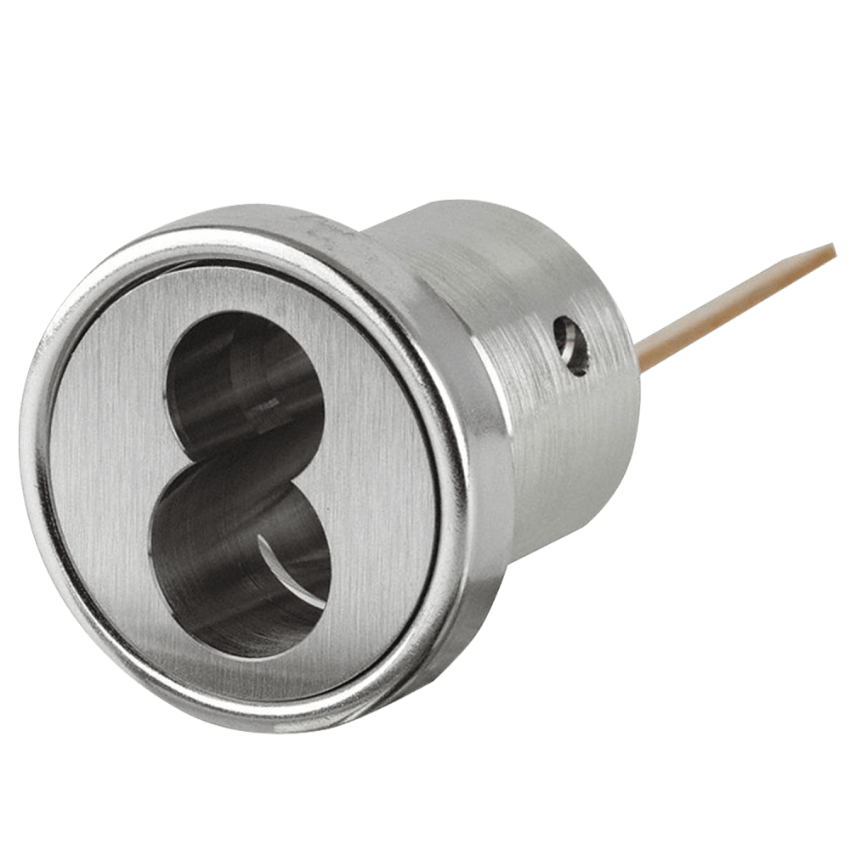
An interchangeable core is a cylinder whose working core can be pulled out and replaced without taking the lock apart. A separate control key retracts a retaining lug and releases the core, which is what makes rekeying a large estate practical.
| Format | What it is | Notes |
|---|---|---|
| SFIC | Small format interchangeable core, the figure eight shape | Used across many brands. Available in six pin and seven pin |
| FSIC | Full size interchangeable core | Some makers and suppliers call this LFIC. The two names mean the same thing |
| KIK | Key in knob cylinder | A cylinder format for knob and lever locks, not an interchangeable core |
| Conventional | Fixed cylinder, rekeyed by taking it apart | Still the most common format on general commercial hardware |
Two points cause confusion at the counter. The core and the housing are ordered separately, so a mortise interchangeable core cylinder is a housing plus a core, not one part. And the words cylinder, core, plug and housing get used interchangeably when they describe different things, which is worth being precise about on a purchase order.
If you are planning a key system rather than replacing one cylinder, our master key system design guide covers levels of keying and construction keying, and the Schlage key systems guide covers keyway families and cylinder formats.
What Goes Wrong When People Order Cylinders?
Almost every wrong order traces back to one of six things. None of them are exotic.
| Mistake | What happens | How to avoid it |
|---|---|---|
| Wrong cam | Threads in, key turns, lock does not operate | Identify the lock body first, then match the cam to it |
| Wrong diameter | Will not start on the thread at all | Check standard against jumbo before assuming a thread fault |
| Wrong length | Sits proud, or does not reach the retractor | Measure the old part and stay inside one manufacturer family |
| Collar forgotten | Correct cylinder looks wrong on the door | Order the collar at the same time as the cylinder |
| Tailpiece not addressed | Rim cylinder will not engage, or binds | Plan to cut it, and match the original protrusion |
| Keyway mismatch | Cylinder fits the lock but not the key system | Confirm the keyway and whether it is keyed alike or master keyed |
Before you place the order, write down six things: the lock make and model, the cam pattern, the nominal length, the finish code, the keyway, and whether the cylinder has to work on an existing key system. That list closes almost every gap. Our commercial door hardware finish guide covers the finish codes if you are matching an existing opening.
Need the cylinder, the cam or the collar? Browse deadbolt parts and diagrams, mortise lock replacement parts and diagrams and exit device parts, or use the diagram lookup across all products and parts to confirm a component before ordering. Call 845-935-0301 if you are not sure which cam you need.
About the Author
Security Parts has supplied repair parts for commercial door hardware since 2001, covering Von Duprin, LCN, Schlage, Falcon and Detex at the component level. Our diagram based lookup exists so a technician can confirm which part they need before ordering rather than after. This guide was written by the Security Parts team from supplier documentation and the questions our customers bring us.
For related reading, see our thumbturn cylinder guide for the keyless side of the same opening, and cylindrical lock parts and diagrams for the format that takes neither a mortise nor a rim cylinder.