 Trusted Since 2001





Quick Summary
Key points
- A passage lock is a latch with handles on both sides and no locking at all. Both levers always retract the latch, so the door simply latches shut and opens from either side.
- Its ANSI function code is F75 for cylindrical locks. Common commercial examples are the Schlage ND10 cylindrical passage latch and the Schlage L9010 mortise passage latch.
- Use it on corridors, open office areas, closets and other doors that need to stay latched but never locked. Because it still latches, it is often used on fire doors that must close and latch.
- If a door needs any locking, from inside or with a key, it needs a privacy, office, classroom or storeroom function instead.
- Before ordering, confirm the series, backset, door thickness, lever design, finish and whether the door is fire rated.
| Feature | Passage lock |
|---|---|
| Locking | None, both sides always free |
| ANSI function | F75 for cylindrical locks |
| Schlage examples | ND10 cylindrical, L9010 mortise |
| Typical doors | Corridors, closets, open office areas |
| Still latches? | Yes, the door latches every time it closes |
In This Guide
- What Is a Passage Lock?
- Where Should You Use a Passage Lock?
- What Is the Difference Between a Passage, Privacy and Office Lock?
- What Specifications Matter on a Commercial Passage Latch?
- Can the Passage Function Work With Access Control?
- What Goes Wrong With Passage Latches?
- Should You Choose a Cylindrical or Mortise Passage Latch?
- How Do You Install or Replace a Passage Lock?
- What Should You Confirm Before Ordering a Passage Set?
- About the Author
Plenty of doors in a commercial building never need locking. They need to close, latch and open easily from both sides, all day, for years. Fitting a keyed lock to those doors only adds keys to manage and functions people can get wrong.
That is the job of a passage set. This guide explains what the passage function does, where it fits, how it differs from privacy and office locks, and which specifications and parts matter when ordering one.
What Is a Passage Lock?
A passage lock is a lockset with the passage function: levers or knobs on both sides that always retract the latch, with no button, turn or key to lock it. In ANSI terms, it is the F75 passage function for cylindrical locks. The inside lever is always free for immediate exit, and so is the outside lever.
The name is slightly misleading, because a passage lock does not lock. It is really a passage latch, and Schlage names its versions exactly that way: the ND10 passage latch and the L9010 passage latch.
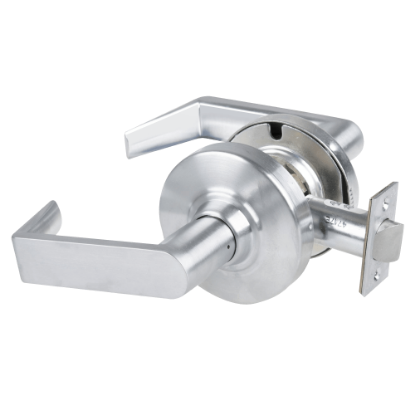
What is a passage lockset?
Passage lockset, passage set and passage door lock all mean the same thing: the complete passage function lock with its levers, latch and strike. In residential hardware it is often called a hall and closet set.
Where Should You Use a Passage Lock?
Use a passage latch on any door that must latch but never needs to be locked.
- Interior corridor doors that divide a building but stay open to everyone.
- Open office areas and meeting spaces with no need for privacy or security.
- Closets and maintenance corridors where latching keeps the door closed but locking is not needed.
- Non-secured stairwell and cross corridor doors that must latch shut.
Can a passage latch go on a fire door?
Yes, when the lock is listed for it. Fire doors need to close and latch, and a passage latch latches every time. The Schlage ND10, for example, is UL10C listed for 3 hour fire doors up to 4 feet by 10 feet.
Always confirm that the specific lock and its options are listed for the door's rating. Our fire rated door guide explains the ratings.
What Is the Difference Between a Passage, Privacy and Office Lock?
All three look similar from the outside. The difference is what happens inside.
| Function | Inside control | Outside lever | Typical door | Schlage example |
|---|---|---|---|---|
| Passage | None | Always free | Corridors, closets | ND10, L9010 |
| Privacy | Push button or turn | Locked when privacy is engaged | Single occupant restrooms | ND40, L9040 |
| Office or entrance | Push button | Locked by the button; key or inside lever unlocks | Private offices | ND50, L9050 |
A classroom lock also has a passage mode: a key in the outside cylinder switches the outside lever between locked and free. The passage function simply has no locked mode at all. Our commercial lock function codes guide explains every function side by side. Our guide to commercial door handles explains levers, knobs and pulls in more detail.
What Specifications Matter on a Commercial Passage Latch?
Grade, backset, latch, strike and fire listing are the details that decide whether a passage latch suits a commercial door. Using the Schlage ND10 as an example:
| Specification | Schlage ND10 |
|---|---|
| Function | ANSI F75 passage, levers both sides, latch retracted by either lever at all times |
| Grade | Exceeds BHMA A156.2 requirements for Grade 1 cylindrical locks |
| Latch | 1-1/8 by 2-1/4 inch square corner faceplate, 1 inch housing, 1/2 inch throw |
| Strike | 1-1/4 by 4-7/8 inch ANSI strike, square corner |
| Backset | 2-3/4 inch standard, 2-3/8 inch optional |
| Fire rating | UL10C listed for 3 hour fire doors up to 4 feet by 10 feet |
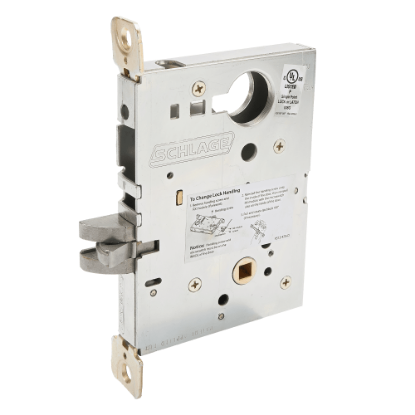
A mortise passage latch such as the Schlage L9010 does the same job in a mortise lock case. The L283-131 lock case for the L9010 is field reversible, so the same case serves both hands.
Can the Passage Function Work With Access Control?
Yes, indirectly. It does not lock, so it cannot control access by itself, but it can report when someone opens the door from inside. The Schlage ND10 chassis is offered in an ND10RX version with a request to exit switch, and the ND10 parts diagram includes an RX switch upgrade kit.
That is useful on doors where an electric strike controls entry and the panel needs to know when someone is leaving. Our guide to door position switches and request to exit explains how those signals are used.
What Goes Wrong With Passage Latches?
Passage latches are simple, so most faults are mechanical and easy to trace.
- Latch does not catch. Usually strike alignment or a door that has dropped. Check the strike before replacing the lock. Our strike plate guide covers alignment.
- Lever sags. The spring cage behind the lever is worn. Replace the spring cage rather than the whole lock.
- Lever turns but the latch does not move. A worn spindle or chassis. On the ND10, a replacement chassis kit is available unassembled with no finished parts, so the levers and roses can stay.
- Door will not stay closed in a breeze. The latch is not projecting fully, or the closer is not bringing the door home.
For the parts behind the lever, our cylindrical lock parts guide and mortise lock parts guide explain each component.
Should You Choose a Cylindrical or Mortise Passage Latch?
Match the rest of the building where you can. If the neighboring doors use mortise locks, a mortise passage latch such as the L9010 keeps the trim, finish and spare parts consistent. If they use cylindrical locks, a cylindrical passage latch such as the ND10 is quicker to install and uses the same parts as the other cylindrical locks.
| Question | Cylindrical passage latch | Mortise passage lock |
|---|---|---|
| Door prep | Cross bore and edge bore | Pocket cut into the door edge |
| Schlage example | ND10 | L9010 |
| Replacing it | Quick, often like for like on the existing prep | Lock case swaps into the existing pocket |
| Best fit | Buildings already on cylindrical locks | Buildings already on mortise locks |
Passage lock or dummy trim?
A passage lock has a working latch operated by the levers. Dummy trim is a fixed handle with no latch at all, used as a pull on doors held shut by something else, such as a roller latch, a closer or the inactive leaf of a pair. If the door needs to latch, it needs a passage latch, not dummy trim.
How Do You Install or Replace a Passage Lock?
Replacing a cylindrical passage latch on an existing door is one of the simpler commercial hardware jobs.
- Confirm the backset and door thickness so the new latch and chassis suit the existing prep.
- Remove the old lock. Release the levers, unscrew the chassis or through bolts, and take out the latch.
- Fit the new latch in the edge bore with the bevel facing the strike.
- Fit the chassis and levers so the spindle engages the latch, then tighten evenly.
- Check the strike. Close the door and confirm the latch catches without slamming. Adjust the strike if needed.
On a mortise passage latch, the lock case slides into the existing pocket, so confirm the case matches the series and backset before ordering.
What Should You Confirm Before Ordering a Passage Set?
Six details: the lock series, cylindrical or mortise, the backset, the door thickness, the lever design, and the finish code. If the door is fire rated, confirm the lock and options are listed for it. If you only need a part, note whether it is the chassis, spring cage, latch or strike.
Browse the Schlage ND10 passage latch and Schlage L9010 passage latch diagrams, or the wider cylindrical lock parts and mortise lock parts sections.
About the Author
Security Parts has supplied repair parts for commercial door hardware since 2001, covering Von Duprin, LCN, Schlage, Falcon, Detex and Adams Rite at the component level. Our diagram based lookup exists so a technician can confirm a part before ordering it. This guide was written by the Security Parts team from supplier documentation and the questions our customers bring us.
If you are not sure whether a door has a passage latch or another function, contact us with a photograph of both sides of the lock and the label inside the chassis, and we will help you identify it.