 Trusted Since 2001





A rim exit device is the most widely installed category of panic hardware in commercial buildings. It mounts on the surface of the door, the latch bolt extends horizontally into a rim strike on the frame or mullion, and it releases in a single push. That simplicity is why architects, contractors, and facility managers have specified rim devices on everything from school corridors to hospital wings for decades.
Understanding how a rim exit device works, which components carry the most wear, and how to identify the right replacement part is not optional knowledge for anyone responsible for commercial door hardware. Building codes, life safety compliance, and operational continuity depend on it.
Quick Answer
- A rim exit device is a surface-mounted panic bar that releases a horizontal latch bolt with a single push. No rods, no floor anchors, no overhead strikes.
- It is non-handed, ANSI/BHMA A156.3 Grade 1 tested, and the most common egress hardware type in commercial buildings.
- The Von Duprin 98/99, 22, 88, and 78 series are the dominant rim device lines in North American commercial specifications.
- Rim devices require specific rail sizes matched to door width. Ordering the wrong rail is one of the most common job-site errors.
- Key replacement parts: center case, dogging assembly, latch bolt, rim strike, end cap kit, and mounting package.
- For fire-rated openings, the device must carry a UL fire-exit hardware listing, not just a panic hardware listing.
- OEM replacement parts for all Von Duprin and Falcon rim series are available at SecurityParts.com with same-day shipping on stocked components.
How a Rim Exit Device Works and Where It Fits in the Exit Hardware Family
Exit devices fall into three configurations: rim, surface vertical rod, and concealed vertical rod. Rim devices are the most common because they are the simplest to install, the easiest to service, and compatible with the widest range of door types.
The mechanism is simple. A horizontal push bar or touchbar sits across the door face. When depressed, it drives an internal linkage that retracts a spring-loaded latch bolt. That bolt, when locked, projects into a rim strike mounted on the door frame or mullion. No rods, no floor anchors, no overhead strikes. The entire function happens in a single surface-mounted housing.
Rim devices are non-handed by design, meaning the same unit works on both left and right swing doors without modification. They are tested to ANSI/BHMA A156.3 Grade 1 standards, which requires the device to survive 2 million operation cycles and resist kick-in forces that would compromise a lower-grade product. For fire-rated assemblies, IBC and NFPA 80 compliance requires that the device be UL listed as fire-exit hardware, not just panic hardware. That distinction matters during inspections.
The dogging feature is one functional detail that separates rim devices used in commercial practice from a basic description. Dogging holds the latch in the retracted position, allowing free push-pull access without engaging the mechanism. It is used on non-fire-rated openings during business hours. On fire-rated doors, dogging is prohibited. Misunderstanding or misusing this feature is one of the most common compliance errors found during fire door audits.
For a full breakdown of how exit device types compare, see the Von Duprin exit device series comparison guide. For panic hardware code requirements and application guidance, see the panic hardware for commercial doors guide.
Rim Exit Device Parts: What Each Component Does
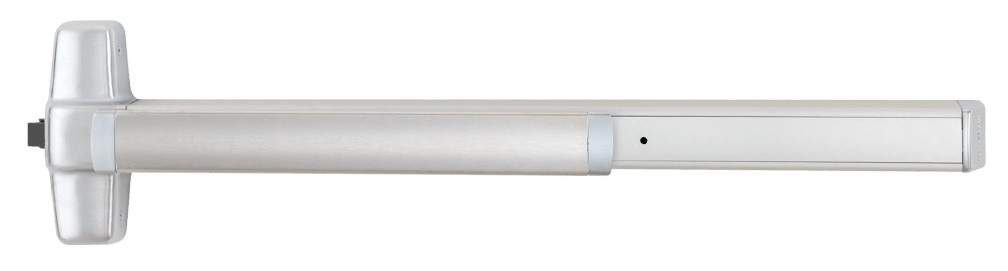
Von Duprin 98/99 series rim exit device. OEM replacement parts for the full 98/99 series are available at SecurityParts.com through the 98/99 series parts catalog.
A rim exit device contains fewer moving parts than most commercial locks, but each component serves a specific function. Knowing what each part does makes the service call faster and eliminates wrong-part orders.
- Push bar / touchbar: The horizontal bar across the door face. When depressed, it drives the latch retraction mechanism. Push bars are solid across the full door width. Touchbars activate from a narrower central section.
- Center case: The internal housing that contains the latch mechanism and connects the push bar to the latch bolt. On the 98/99 series, the center case is the primary structural component and the most frequently replaced case component after heavy use or forced entry.
- Latch bolt: The spring-loaded bolt that projects into the rim strike when the door is in the locked position. Retracts when the push bar is depressed.
- Rim strike: The metal plate mounted on the door frame or mullion that receives the latch bolt. Rim strikes must match the device series. A mismatched strike is the most common cause of intermittent latching failures.
- Dogging assembly: The mechanism that holds the latch in the retracted position. Consists of a dogging shaft, dogging spring, and adapter components. The hex dogging shaft is the highest-wear part on high-traffic non-fire-rated openings.
- End cap kit: The plastic or metal caps that close the ends of the mechanism case. Impact-resistant end caps prevent case damage from carts and equipment in high-traffic corridors.
- Mounting package: The fasteners, through-bolts, and backplates used to secure the device to the door. Includes components for both standard and thick-door applications.
For complete part diagrams and OEM replacement parts by component type, see the exit devices parts guide and the Von Duprin panic bar parts catalog.
Rim Exit Device vs Surface Vertical Rod vs Concealed Vertical Rod
All three exit device types share the same push-bar egress mechanism, but they differ in how the latch engages the door frame and where they are used.
Rim Exit Device
Mounts entirely on the door surface. A single latch bolt engages a rim strike on the frame or mullion. Correct for single doors and the active leaf of double doors with a mullion. The simplest to install, easiest to service, and the most widely specified configuration in commercial construction.
Surface Vertical Rod (SVR) Exit Device
Uses exposed vertical rods running along the door surface to shoot latch bolts at both the top and bottom of the door frame simultaneously. Correct for double doors without a center mullion where a rim device on each leaf would conflict. The exposed rods are serviceable without door removal but are more vulnerable to damage in high-abuse environments. For SVR parts, see the Von Duprin 9847 CVR parts guide.
Concealed Vertical Rod (CVR) Exit Device
Same multi-point latch engagement as SVR but with rods concealed inside the door stile. Preferred where exposed hardware is architecturally unacceptable. Requires a mortised door preparation, making it more expensive to install and more complex to service. For CVR parts, see the Von Duprin 9947 CVR parts guide.
For most single-door commercial applications, the rim exit device is the correct specification. SVR and CVR configurations address specific double-door and architectural requirements that a rim device cannot meet.
Rail Sizing and Door Width: Getting This Right Before You Order
Rim exit device rails are manufactured in standard lengths that correspond to door width ranges. Ordering the wrong rail size is one of the most common job-site problems with exit devices, and it is entirely avoidable if you confirm the door width before placing the order.
Most manufacturers produce four standard rail sizes covering doors from approximately 24 inches to 48 inches wide. A standard commercial 36-inch door typically requires the rail sized for the 33-to-36-inch door width range. The rail is cut at the factory to the top of its range, so if you order the wrong size bracket, the device will not mount correctly to the door.
Narrow stile doors , most commonly aluminum-framed storefront doors , require a narrow stile device. Standard wide stile rim devices will not fit on narrow stile aluminum frames. The Von Duprin 78 Series is the correct specification for narrow stile aluminum doors. Standard-width 98/99, 22, and 88 series devices are for wide stile doors only.
Always note the exact door width and stile type before ordering any rim exit device or replacement rail component. If you are replacing a rail on an existing device, confirm the door width and the existing rail size from the device's model label before ordering.
Code and Compliance Requirements for Rim Exit Devices
Rim exit devices installed on commercial openings are subject to several overlapping code requirements. Non-compliance creates inspection failures, liability exposure, and in fire-rated applications, potential invalidation of the door assembly's fire rating.
ANSI/BHMA A156.3 Grading
All commercial rim exit devices must meet ANSI/BHMA A156.3 standards. Grade 1 is required for commercial applications and represents the highest level of cycle testing (2 million operations) and forced entry resistance. Grade 2 is permitted for lighter commercial applications. For a full explanation of ANSI grading across all commercial hardware, see the ANSI/BHMA door hardware standards guide.
Panic Hardware vs Fire-Exit Hardware
A rim exit device on a non-fire-rated door must carry a UL 305 panic hardware listing. A rim exit device on a fire-rated door must carry a UL 10C fire-exit hardware listing. These are two separate UL certifications. The UL label is stamped on the device body. Installing a panic-only device on a fire-rated opening creates an immediate compliance failure. For fire door assembly requirements, see the commercial door fire rating guide.
ADA Mounting Requirements
The Americans with Disabilities Act requires that exit device push bars be mounted between 34 and 48 inches above the finished floor. The push force required to activate the device must not exceed 5 pounds on any door required to be accessible. Most Grade 1 rim exit devices meet this threshold under normal operating conditions. Verify the operating force after any major service that involves the latch mechanism or push bar assembly.
NFPA 101 and Dogging Prohibition
NFPA 101 and NFPA 80 prohibit the use of the dogging feature on fire-rated openings. The dogging mechanism holds the latch retracted, which would prevent the door from latching automatically on closing , a requirement for all fire-rated assemblies. A hex dogging key must not be left in place on any fire-rated door. Some devices include automatic dogging release features that disengage when the fire alarm activates.
The Von Duprin Series That Dominate Commercial Specifications
When a specification sheet calls for a rim exit device, it is almost always pointing at one of these.
Von Duprin 98/99 Series is the flagship. The 98 has a smooth mechanism case, the 99 has a grooved case, and internal components are identical between the two. This series handles the full range of commercial applications from office buildings to institutional facilities. Parts are stocked, service documentation is thorough, and compatibility across generations of the same series is well-maintained. The catalog covers center cases, dogging assemblies, latch components, end caps, and electrified options including electric latch retraction. Browse the Von Duprin 98/99 series parts catalog or the 98/99 series parts and service guide.
Von Duprin 22 Series is the entry-level rim device for medium and low-traffic openings. It carries Grade 1 certification and shares much of the same design logic as the 98/99, but at a lower price point. The 22 Series is appropriate for office interiors, retail, and lighter institutional applications. See the 22 Series parts catalog and the Von Duprin 22 series parts guide.
Von Duprin 88 Series is the heavy-duty option, designed for high-security and abuse-resistant environments. Correctional facilities, government buildings, and any application where the device takes physical punishment from forced entry attempts or continuous heavy use. The 88 Series reflects that specification with reinforced construction throughout. See the 88 Series parts catalog and the Von Duprin 88 Series buyer's guide.
Von Duprin 78 Series covers narrow-stile aluminum doors. These are the all-glass storefronts and aluminum framed doors common in retail and commercial lobbies. The 78 Series is a specialized narrow-stile rim device, and its parts are not interchangeable with the standard-width series. If you are servicing an aluminum frame storefront door, confirm you are working with 78 Series hardware before ordering anything. See the 78 Series parts catalog and the Von Duprin 75/78/88/94/95/54 series parts guide.
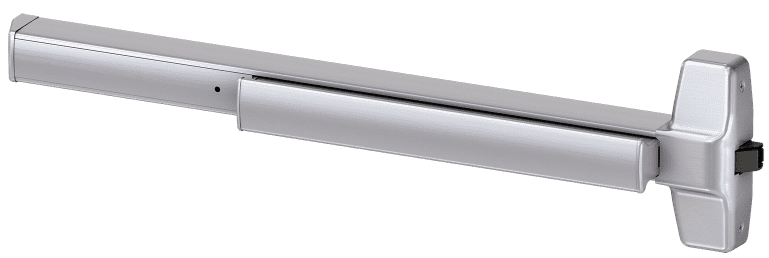
Von Duprin 78 Series narrow stile rim exit device. Required for aluminum storefront and all-glass door applications. OEM replacement parts available through the 78 Series parts catalog at SecurityParts.com.
The full catalog of rim exit devices, including all Von Duprin and Falcon series, is organized by model with interactive parts diagrams. You select the brand, select the series, and the parts are laid out visually against a diagram of the device so you can confirm exactly what you are ordering before it ships. Browse the complete exit devices catalog at SecurityParts.com.
For a side-by-side comparison of all Von Duprin series, see the Von Duprin exit device series comparison. For the full Von Duprin parts catalog across all product lines, see the Von Duprin parts guide.
Electrified Rim Exit Device Options: EL, QEL, and MEL
Rim exit devices can be ordered or upgraded with electrified options that integrate with access control systems. These options add electronic control over the latch bolt while maintaining the push-bar egress function required by code.
Electric Latch Retraction (EL)
The EL option retracts the latch bolt electronically via a solenoid. When the access control system sends an unlock signal, the bolt retracts and the door can be pulled open from outside without operating the push bar. EL devices draw significant inrush current on activation and require proper power supply sizing.
QEL and MEL: Quiet and Motor-Driven Options
Standard EL devices produce a mechanical snap when the solenoid fires. QEL (Quiet Electric Latch Retraction) uses a different mechanism to reduce that sound, which is important in healthcare, judicial, and education environments where door hardware noise is a functional concern. MEL (Motor-Driven Electric Latch Retraction) uses a motor rather than a solenoid and typically draws lower steady-state current. For a detailed comparison, see the QEL vs MEL guide.
If you are integrating a rim exit device with an electric strike on the same opening, see the electric strike parts guide and the Von Duprin electric strike parts guide. For electric strike selection and access control integration, the electric strikes catalog is organized by type and compatibility.
Why Security Parts Is the Right Source for Rim Exit Device Components
Every contractor, locksmith, and facility manager has dealt with the same problem at least once: the part arrives, it looks right, and it does not fit. Wrong generation, wrong finish, wrong series variant. The return takes five business days. The door stays out of compliance. The inspection gets flagged.
That problem does not come from ordering the wrong brand. It comes from sourcing parts through a platform that was not built for the precision this hardware demands. Security Parts was.
Built Around How Field Professionals Actually Work
Most hardware distributors organize their catalogs by category and manufacturer, which works fine for specifying new equipment. It breaks down completely when you are on a service call trying to replace a dogging spring on a Von Duprin 99 from a 2009 installation and you need to know whether the current part number still applies.
Security Parts is organized model-first. Every series, from the Von Duprin 98/99 to the 22 Series, the 78 Series for narrow-stile aluminum doors, and the 88 Series for heavy-duty applications, has its own dedicated page. Parts are categorized by component type within each model: center cases, dogging assemblies, latch components, end caps, electrified options. You are not scrolling through 400 line items trying to match a number from a service manual.
The interactive diagrams are what make the difference on a time-sensitive call. Before you add anything to the cart, you can confirm the component visually against an exploded diagram of your specific device. That single step eliminates the majority of wrong-part returns that plague sourcing through general distributors.
Over Two Decades in Commercial Door Hardware
Security Parts has been in the commercial door hardware business since 2001. That tenure matters because the exit device catalog in most commercial buildings spans multiple decades of hardware. A school built in 1998 may still be running original Von Duprin devices on fire-rated corridor doors. A hospital renovation from 2011 might have a mix of legacy and current-generation hardware on the same floor.
Knowing which part numbers cross-reference across generations, which components were revised and when, and which series share interchangeable components requires the kind of institutional knowledge that comes from two decades of working in this specific product category. That knowledge is baked into how the catalog is structured, not something you have to extract from a customer service call.
Shipping That Matches the Reality of Commercial Maintenance
When a rim exit device fails on a fire-rated opening, the timeline is not flexible. Common components are stocked across multiple US warehouses, and most orders are processed the same business day. UPS ground is the default carrier, with expedited options available when the situation requires it. Free shipping applies to orders over $450, which is a realistic threshold for any multi-part service call or facility stock order.
Support Before the Order, Not After
The team at Security Parts is reachable by phone at 845-935-0301 and by email at sales@securityparts.com. The value of that access is not general customer service. It is pre-order compatibility confirmation. If you have an older device and you are not certain whether a current part number applies to your specific generation, that is the conversation to have before the order ships, not after it arrives wrong.
One Catalog for the Entire Door Opening
A rim exit device rarely fails in isolation. The service call that starts with a broken dogging spring often reveals a door closer that needs attention or an electric strike that has been failing intermittently on the same opening. Security Parts carries replacement components across the full door hardware ecosystem, organized with the same model-specific structure as the exit device catalog. Browse door closer parts, electric strike parts, and the full commercial door hardware parts catalog at SecurityParts.com. That continuity reduces the number of vendors you are coordinating across a single project and means your parts arrive from one source on one timeline.
For guidance on when to use OEM parts vs aftermarket alternatives on commercial hardware, see the OEM vs aftermarket commercial door hardware guide. For a complete commercial maintenance schedule that covers exit devices and all related hardware, see the commercial door hardware maintenance checklist.
Conclusion
Rim exit devices are not complicated hardware. What makes them difficult is the precision required to order and replace individual components correctly, particularly on legacy devices where part-number drift across product generations can send even experienced technicians in the wrong direction.
The path to getting it right is the same every time: identify the exact series, locate the component visually against a parts diagram, confirm finish and generation compatibility, and order from a source that ships quickly and backs the transaction with real hardware knowledge. Security Parts offers that process for the full range of Von Duprin and Falcon rim exit devices, with same-day shipping on stocked components and accessible support for the compatibility questions that come up before the order goes through. Go directly to the exit devices catalog for the device you are servicing or call 845-935-0301 to confirm compatibility before ordering.
About the Author
This guide is published by the commercial door hardware team at SecurityParts.com, a supplier of OEM Von Duprin, Schlage, LCN, Falcon, and Detex parts since 2001. Technical specifications, ANSI/BHMA standards references, and series compatibility information are verified against live SecurityParts.com product pages and manufacturer documentation. For rim exit device part identification and same-day shipping, call 845-935-0301 or visit the SecurityParts.com contact page.